
Why the Right AseptiQuik Connector Setup Matters in Tubing Assembly

In cleanroom and bioprocess environments, selecting the right AseptiQuik connector is only part of the process. Just as important is how it is integrated into the tubing assembly itself. When teams are working with sanitary fittings, reinforced braided tubing, and larger connector formats, the assembly process can become more challenging. That is why it helps to think about this product as part of a complete workflow rather than as a standalone component.
CPC offers several types of AseptiQuik connector products for different process requirements, including options for small flow paths, general-use sterile connections, and larger-volume applications. That range is useful because not every tubing setup requires the same size, flow capacity, or handling method. In many applications, the connector and the tubing need to be considered together to achieve a smooth and repeatable result.
What Is an AseptiQuik Connector?
It is a type of sterile connector used to join tubing lines in bioprocess and single-use fluid transfer systems. Its purpose is to allow two fluid paths to be connected quickly while helping maintain sterility during the connection process. This is especially important in applications where liquids, media, or other process fluids need to move through tubing without exposing the system to unwanted contamination.
The AseptiQuik product line includes several styles and sizes to fit different process requirements. Some are designed for smaller flow paths, while others are built for larger transfer needs or more specialized applications. Because of that, selecting the right AseptiQuik connector is not only about choosing a sterile connection point. It is also about making sure the connector matches the tubing, the fitting size, and the overall assembly process.
Why Connector Integration Matters
Even the right AseptiQuik connector can be difficult to assemble if the tubing application is more demanding. This is especially true when reinforced braided tubing is involved. Braided often offers added strength and durability, but it can also make fitting insertion more difficult than it would be with standard tubing. When larger sanitary connectors are part of the setup, that challenge can increase even more.
This is where integration with the right equipment becomes important. Instead of relying entirely on manual force, a fitting inserter can help support a more controlled process. That can improve repeatability, reduce assembly strain, and create a more practical workflow for operators handling difficult tubing and connector combinations.
Large Aseptic Connector Insertion with the CRD430
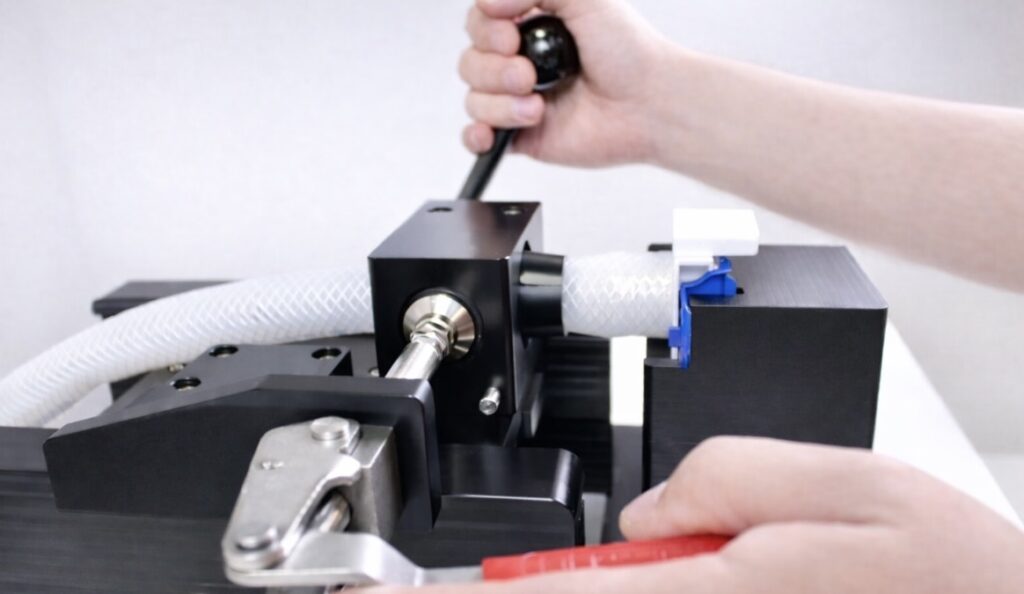
Larger AseptiQuik connector assemblies can require more control during tubing insertion, especially when reinforced braided type is involved. The CRD430 Large Manual Fitting Inserter helps support this type of application by giving operators a more controlled way to insert large aseptic connectors into demanding combinations. This makes it easier to see how Clean Room Devices equipment can support integration when manual insertion alone may be less consistent or more difficult.
AseptiQuik L Connector with Heavy Duty Fitting Inserter
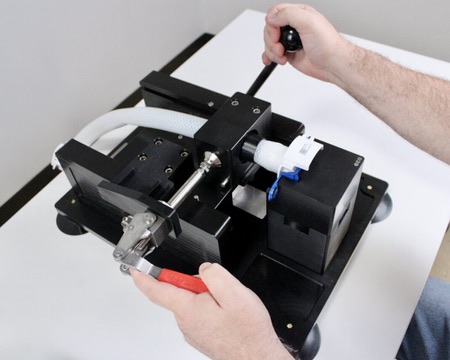
The AseptiQuik L connector is a strong example of how connector size and tubing type can affect assembly. When paired with Sani-Tech STHT-R braided reinforced tubing, the insertion process can be more challenging and may benefit from a more robust device-assisted approach.
Our Heavy Duty Fitting Inserter is designed for this kind of demanding tubing assembly work, helping create a more practical and repeatable process for larger sanitary applications. This can be especially valuable in cleanroom and bioprocess environments where consistency during assembly is important to the overall workflow.
What to Consider When Choosing a Setup
When evaluating an AseptiQuik connector assembly, it helps to consider how the connector, tubing, and insertion process work together. We design equipment for more demanding tubing assembly applications, especially when fittings are more complex or the tubing is harder to work with.
A few important factors to think about include:
- Size- The CRD430 is designed for flexible tubing from 1/4 inch to 1-5/8 inch O.D.
- Type- Reinforced or braided tubing may require more controlled insertion than standard flexible tubing
- Fitting geometry- Larger sanitary fittings or more complex barb designs can make assembly more challenging
- Repeatability needs- If consistency matters from one assembly to the next, a dedicated inserter may be more effective than manual insertion alone
- Changeover flexibility- Fast reconfiguration and a rotating nest for multi-barb fittings, which can be helpful when working with different tubing and connector combinations
Building a More Reliable Process
The value of an AseptiQuik connector goes beyond the connection itself. In cleanroom and bioprocess applications, the full assembly process plays an important role in achieving consistent, reliable results. At Clean Room Devices, we focus on equipment that helps support more controlled tubing assembly, especially in applications involving reinforced tubing, sanitary fittings, and more challenging connector insertion. With the right combination of connector, tubing, and insertion support, teams can create a smoother process that better supports performance, repeatability, and day-to-day efficiency.