
Choosing the Right Medical Tubing Expander for Cleanroom Workflows

A medical tubing expander can help make fitting insertion more controlled, repeatable, and efficient in cleanroom production. When tubing needs to be expanded before a fitting, connector, or counterpart is inserted, the right equipment can reduce hand strain and support a more consistent process. At Clean Room Devices, we offer pneumatic and electro-pneumatic tubing expanders designed for plastic, rubber, and flexible tubing materials used in medical, cleanroom, and manufacturing environments.
Why Tubing Expansion Matters
It is often needed when a fitting must be inserted into flexible tubing. Instead of forcing the fitting by hand, an expander temporarily opens the tubing through controlled internal expansion, allowing the fitting to be inserted more easily and consistently.
This is especially important in cleanroom and medical device production, where repeatability matters from part to part. A medical tubing expander helps create a more controlled assembly process, while our stainless steel jaws and cleanroom-compatible construction support accurate, repeatable expansion.
Understanding the CRD200, CRD201, and CRD202
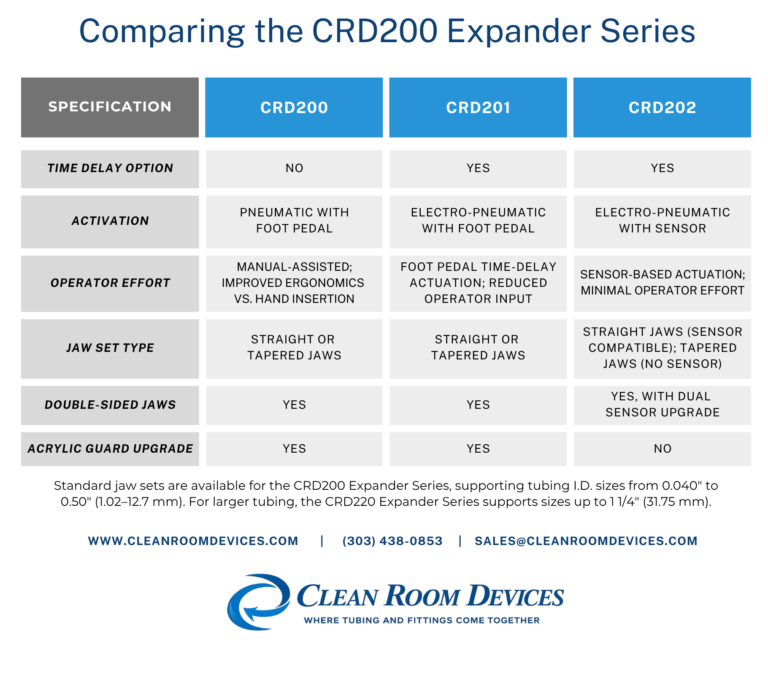
The CRD200 Series comparison chart is a useful guide for understanding how the three models differ.
The CRD200 is pneumatic with foot pedal activation. It does not include a time-delay option, but it is designed as a manual-assisted tool that improves ergonomics compared with hand insertion. This can make it a strong fit for teams that want a straightforward air-powered option without adding electrical requirements.
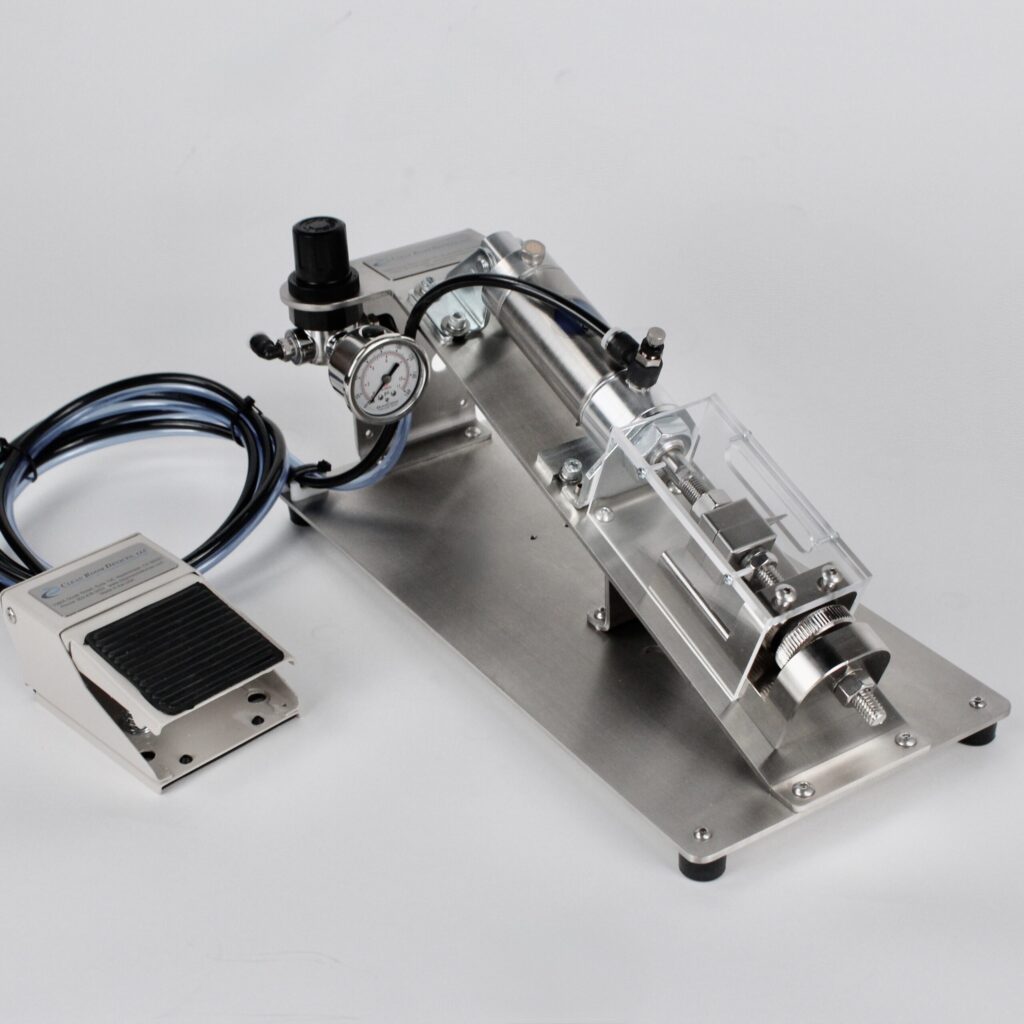
The CRD201 is electro-pneumatic with foot pedal activation. According to the chart, it includes a time-delay option and offers reduced operator input through foot pedal time-delay actuation. This makes it useful for production teams that want more control over expansion timing while keeping foot pedal operation.
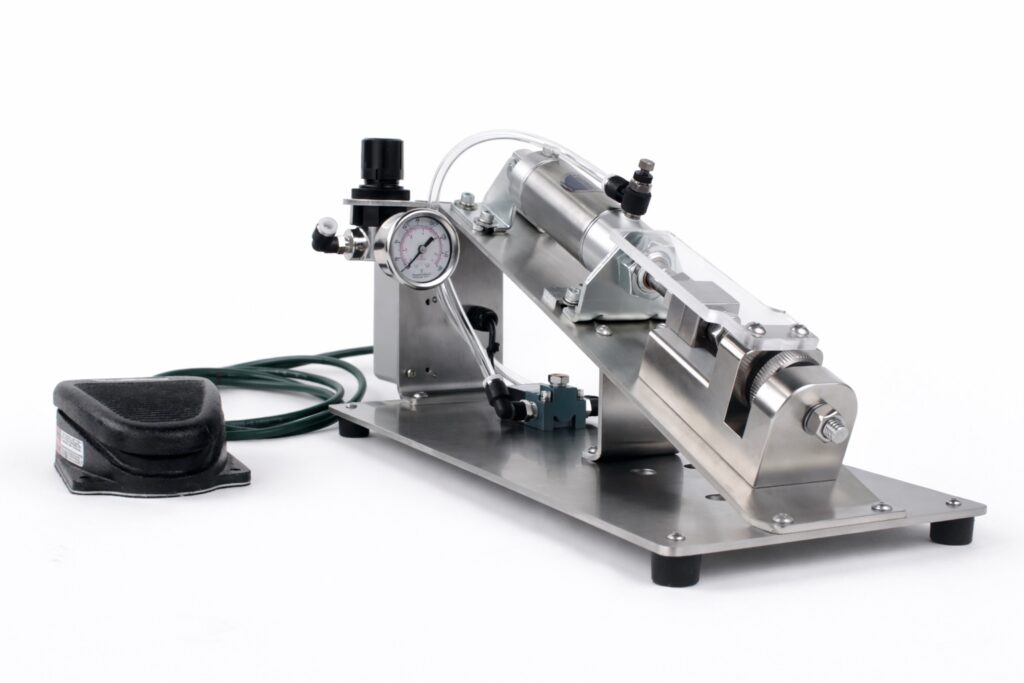
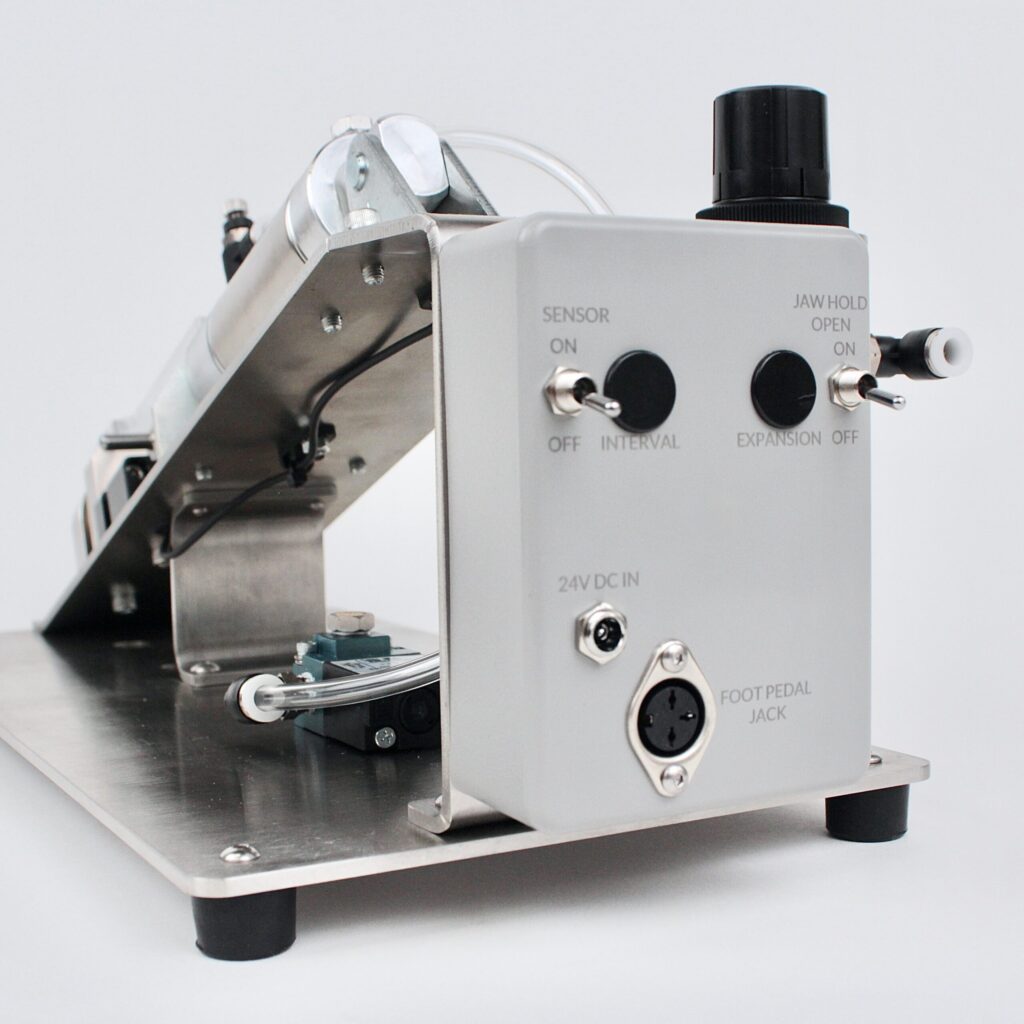
The CRD202 is electro-pneumatic with sensor activation. The chart shows that it includes a time-delay option and is designed for sensor-based actuation with minimal operator effort. For higher-repetition workflows, this style of medical tubing expander may help reduce manual input while supporting a more automated process.
Key Questions to Ask Before Choosing a Model
Before selecting equipment, it helps to review how the medical tubing expander will be used on the production floor. A few practical questions include:
- Will operators use the tool occasionally or throughout the day?
- Is compressed air available in the work area?
- Is electrical power available for electro-pneumatic operation?
- Does the process need time-delay control for repeatability?
- Will foot pedal activation or sensor activation better fit the workflow?
- What tubing size and material need to be expanded?
These questions can help narrow the choice between options without focusing only on price or model number.
Expansion Controls, Jaw Options, and Application Fit
When comparing the CRD200, CRD201, and CRD202 medical tubing expanders, the biggest differences come down to how the equipment is activated, how much operator input is required, and which jaw setup best fits the application. Instead of choosing a medical tubing expander by model number alone, teams should look at how the tool will be used in daily production.
Key factors to consider include:
- Activation style: Foot pedal or sensor-based operation
- Time-delay control: Helpful for more consistent expansion timing
- Operator effort: Important for repetitive workflows
- Jaw selection: Based on tubing material, size, and fitting type
- Tubing range: Standard or larger-diameter applications
In cleanroom and medical device production, these details can help teams match the expander to the process, the operator, and the tubing being assembled.
Matching the Expander to Your Application
The best choice is the one that supports the way the process actually runs. Teams should consider how often the equipment will be used, how much operator input is practical, what level of repeatability is needed, and whether the setup should stay simple or include more automated features. By looking at the full application, we can help match the right expander style to the tubing, fittings, workflow, and production environment.
We offer medical tubing expanders for cleanroom and manufacturing applications where controlled expansion can support easier fitting insertion and more repeatable results. By comparing activation style, time-delay control, jaw compatibility, operator effort, and tubing size, teams can choose equipment that fits both the application and the people using it.